| The 6th Summer Davos Forum Opens – Premier Wen Jiabao Attends the Opening Ceremony and Delivers a Speech |
| 2012-09-11 20:58 |
|
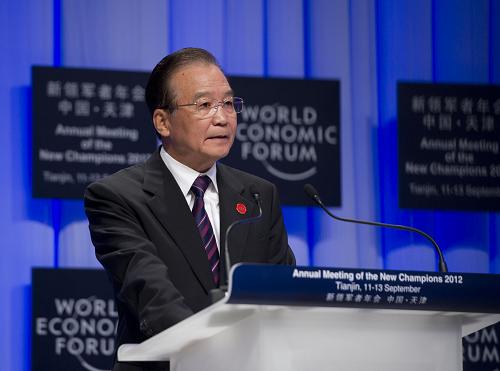
On the afternoon of Sep. 11, 2012, the World Economic Forum's Annual Meeting of the New Champions 2012 (the 6th Summer Davos Forum) opened in Mei Jiang Exhibition Center, Tianjin. Wen Jiabao, Member of the Standing Committee of the Political Bureau of the CPC Central Committee and Premier of the State Council of the People's Republic of China, attended the opening ceremony and delivered a speech. He stressed that China's development is still in an important phase of strategic opportunities. The advances in industrialization, urbanization, information technology and agricultural modernization will unleash huge development potentials and the giant ship of the Chinese economy will sail ahead fast yet steadily and reach the shore or a brighter future. Premier Wen first reviewed the course of economic and social development of China in the past decade. He said that fast growth and low fluctuation was the most salient feature China's economic performance in the past decade. A shift from fast growth to sound growth was a fundamental change in the priorities of China's development in the past decade. To put people's needs first was the most visible highlight in China's development in the past decade. China executed the concept of sustainable development in the past decade. To build a resource-saving and environment-friendly society was identified as an important strategy of national development. China's reform made continuous breakthroughs in the past decade, which has been the most distinctive feature of the time. From 2002 to 2011, China's GDP grew at an average annual rate of 10.7%, and moved up from the sixth to the second place in the world. China's per capita GDP rose from 1,000-plus U.S. dollars to 5,432 U.S. dollars. China's foreign trade volume also climbed from the sixth to the second place in the world, and foreign exchange reserves exceeded three trillion U.S. dollars. China's industrial structure was upgraded, its agricultural foundation was consolidated, and regional development became much more balanced. All-round progress was made in social programs and people's livelihood significantly improved. Premier Wen gave particular emphasis on the major progress China made in the areas that concern people's livelihood, such as employment, social security, education, health, and poverty alleviation. He said that the per capita urban disposable income and per capita rural net income increased at an average annual rate of 9.2% and 8.1% respectively in real terms, making the past decade one of the fastest-growing periods in the history of New China. Rural income grew faster than urban income in the past two years. Hundreds of millions of Chinese families and the towns and villages where they live and work experienced tremendous changes in these past ten years, and there were numerous touching stories of Chinese people changing their lives and destinies through hard work and perseverance. Premier Wen also summed up China's practice and experience in coping with the global financial crisis in the past almost 5 years. He said that after the international financial crisis broke out China fully implemented a package of plans, making parallel efforts in overcoming current difficulties and pursuing long-term development. It was exactly due to China's resolute decision and scientific response that China was able to avoid factory closures, job losses and return of migrant workers to their home villages. These measures helped China keep the good momentum of economic development, maintain social stability and harmony and protect China's modernization process from major setbacks. Over the years, social wealth has increased, asset quality has improved and China's capacity to resist risks has enhanced. From 2009 to the end of 2011, China began construction of 21 million units of urban housing for low-income earners, among which 11 million units have been basically completed. The operational mileage of railways was increased by 13,500 kilometers and the mileage of highways was increased by 376,000 kilometers. Infrastructural facilities such as urban rail transport and rural power grid were significantly improved. Over 7,000 large- and medium-sized reservoirs and key small aging reservoirs were reinforced. China extended access to potable water to many more rural residents. A large number of community facilities providing medical, health, educational and cultural services were established. A new Wenchuan was built and all-round progress was made in the economic and social development of the disaster-stricken areas. Meanwhile, China had fiscal and financial risks under control. The budget deficit and outstanding government debt in 2011 were 1.8% and 15.28% of the GDP, both lower than their 2002 levels of 2.57% and 16.07%. The ratio of non-performing loans in the banking sector went down from 15.2% at the end of 2003 to 1.8% in 2011. The scale of local government debts was on the whole stable and risks were basically under control. Premier Wen said, "As I look back at each and every step I took in the past ten years, strong emotions well up inside me. They are emotions of a deep love and strong confidence that I have always cherished towards my beloved country, an ancient civilization brimming with youthful energy. Through ten years of hard work, we have elevated our economic and social development to a new level and laid a more solid material, technological and institutional foundation for future development." While introducing the extensive policy measures taken by China since may, Premier Wen said that macroeconomic indicators show that the speed of growth is still within the target range set at the start of the year, and although the growth is slowing down, it is being more stable. As the recent measures are being implemented and take effect, the Chinese economy is expected to further stabilize. China will step up anticipatory adjustments and fine-tuning. China will make stronger efforts to spur consumer demand, expand effective investment with a focus on releasing the potentials of nongovernmental investment, stabilize external demand and bolster the real economy. Looking into the prospects of the global economy, Premier Wen said that the international community needs to strengthen macroeconomic policy coordination, push forward reform of the global governance structure, resolutely oppose trade and investment protectionism, advance trade and investment liberalization and facilitation, and work jointly for an early steady recovery of the world economy. He expressed the hope that entrepreneurs of all countries will invest more in technological R&D and product innovation, vigorously develop green industries that are energy-efficient and environment-friendly, create new market demands and growth areas, and bring about an all-win outcome where businesses boom, industries get stronger, economy prospers and society progresses. Premier Wen answered the questions after the speech. Before the opening ceremony, Premier Wen attended the dialogue with business representatives coming to attend the annual meeting. Executive Chairman of the World Economic Forum Klaus Schwab, President of Rwanda Paul Kagame, Danish Prime Minister Helle Thorning-Schmidt, Latvian Prime Minister Valdis Dombrovskis, Lithuanian Prime Minister Andrius Kubilius, Pakistani Prime Minister Raja Pervez Ashraf, Vice President of Costa Rica Luis Liberman, Deputy Prime Minister of Zimbabwe Arthur Mutambara, former Australian Prime Minister Kevin Rudd, Singaporean Emeritus Senior Minister Goh Chok Tong, former British Prime Minister Gordon Brown and other world leaders attended the opening ceremony. Zhang Gaoli, Member of the Political Bureau of the CPC Central Committee and Secretary of the CPC Tianjin Municipal Committee, Vice Chairman Huang Mengfu of the National Committee of the Chinese People's Political Consultative Conference (CPPCC) and Wan Gang also participated in the meeting. The three-day forum takes "Creating the Future Economy" as the theme. The participants will focus their discussions on addressing the current challenges in a creative way, understanding the new frontiers of science and technology and other relevant topics. |
 Suggest To A Friend Suggest To A Friend |
 Print Print |
