| Foreign Ministry Holds Briefing for Chinese and Foreign Media on President Hu Jintao's Visit to Austria and Attendance at the Sixth G20 Summit | ||||
| 2011-10-29 16:08 | ||||
|
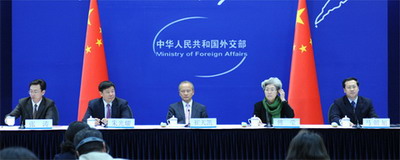
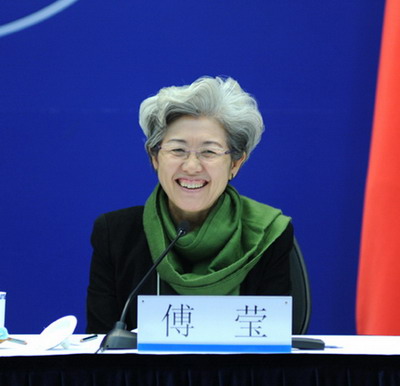
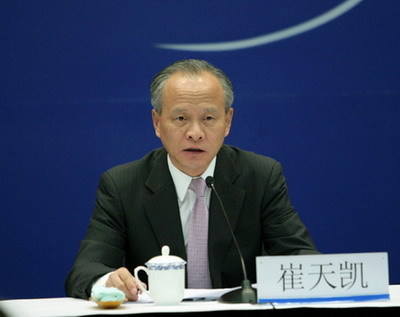
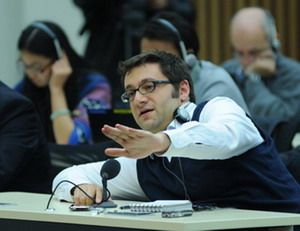
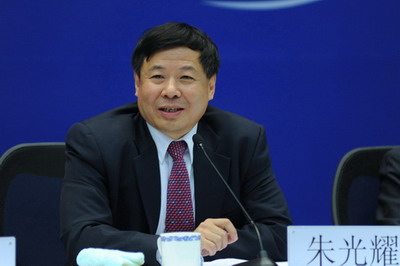
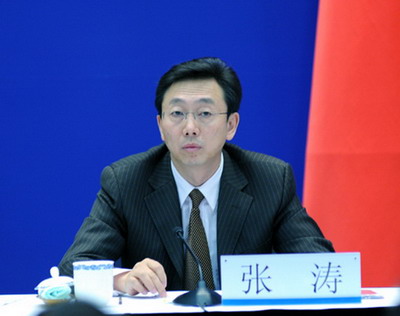
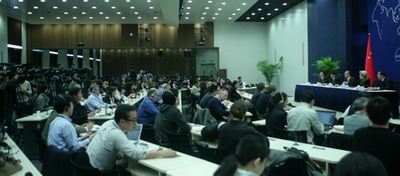
On October 28, 2011, the Ministry of Foreign Affairs (MFA) held a briefing for Chinese and foreign media. Vice Foreign Minister Cui Tiankai, Vice Foreign Minister Fu Ying, Vice Minister of Finance Zhu Guangyao and Director of the International Department of the People's Bank of China Zhang Tao introduced the background, main activities and significance of President Hu Jintao's upcoming visit to Austria and attendance at the sixth G20 summit and took questions of journalists. Director-General of the MFA Information Department Ma Zhaoxu chaired the briefing and over 100 Chinese and foreign journalists were present.
I. President Hu Jintao's Visit to Austria Fu Ying said that President Hu will pay a state visit to Austria from October 30 to November 2 at the invitation of Austrian President Heinz Fischer. During the visit, Hu will hold talks with Fischer and meet with Austrian Chancellor and Parliamentary Speaker to exchange in-depth opinions on the bilateral relations and issues of common interest. This year marks the 40th anniversary of China-Austria diplomatic ties. Over the past 40 years, China and Austria achieved long-term progress of bilateral relations, maintained frequent high-level exchanges and made fruitful economic and trade cooperation. The bilateral trade volume exceeded US$6 billion last year. China is Austria's largest trade partner outside Europe. The bilateral exchanges and cooperation on education, culture, science, technology and tourism continue expanding and growing and communications and coordination in such multilateral organizations and institutions as the UN remain sound. She pointed out that the last visit of Chinese head of state to Austria was paid 12 years ago and this visit of President Hu aims at enhancing political mutual trust, reviewing and planning the development of bilateral relations, expanding mutually beneficial economic and trade cooperation and promoting bilateral cultural exchanges. The two sides will exchange views on the regional and international issues of common interest. She believes that Hu's visit will achieve full success with the joint efforts of both sides.
II. President Hu Jintao's Attendance at the Sixth G20 Summit Cui Tiankai said that President Hu will attend the sixth G20 summit in Cannes, France from November 3 to 4 at the invitation of French President Nicolas Sarkozy. According to the arrangement of the host country, Hu will attend the plenary session, working lunch and working dinner of G20 leaders and participate in the discussions on world economy, the "Framework for Strong, Sustainable, and Balanced Growth", reform of the international monetary system, bulk commodity prices, global governance, trade, development and financial regulation. He will also hold bilateral meetings with related national leaders and officials of international organizations. He noted that G20 is an important platform for global economic governance. China hopes the summit carries forward the spirit of win-win partnership and maintains, uses and develops the G20 mechanism. Priority should be given to the following tasks:
First, strengthen solidarity and cooperation of G20 members. Members should make democratic consultations, join hands together, step up coordination, support each other's macroeconomic policies, stabilize the financial market, boost market confidence and promote world economic growth. Efforts should be made to seek development while maintaining stability and achieve win-win results through cooperation. Second, focus on the major and pressing international economic and financial issues. The sovereign debt crisis of developed countries, high and volatile bulk commodity prices and rising global inflation pressure should be handled properly and reform of the international monetary and financial system should be pushed forward. Among the three pillars of strong, sustainable and balanced growth advocated by G20, priority should be given to maintaining strong growth and cementing the hard-won economic recovery. Third, continue to firmly oppose trade protectionism. It is important to push the Doha Round to achieve the target of development round and reiterate the G20 members will not set new restrictions on goods, investment or services. The needs of economic and trade development of the least developed countries should be taken care of and positive progress should be achieved on issues of their concern. Fourth, continue to pay attention to the North-South development imbalance. The positive contributions made by emerging markets and developing countries to world economic recovery and growth should be objectively recognized and an enabling environment should be built for their development. On issues of reform of the international monetary system, global economic governance and bulk commodity prices, views of emerging markets and developing countries should be valued and their representation and voice should be raised.
Zhu Guangyao said that the G20 Cannes summit in which President Hu will participate is a significant event and will have a major influence of promoting global economic recovery and growth and maintaining international financial market stability. To make policy preparations for the summit, the G20 financial ministers and central bank governors held their last meeting prior to the Cannes summit in Paris, France from October 14 to 15 and issued a joint communiqué. Consensus has been reached in several important aspects. The G20 financial ministers and central bank governors agreed that the global economy faces rising downside risks and G20 members should take decisive countermeasures to recover market confidence, keep the stability of banking system and financial market and boost economic recovery and growth. They expect the Euro zone to take further measures to maximize the influence of European Financial Stability Fund, avoid sprawl of crisis and handle challenges through the implementation of a comprehensive plan. To address the short-term economic vulnerability and strengthen the foundation of strong, sustainable and balanced economic growth in the medium term, they will submit a Cannes Action Plan composed of coordinated policy measures to the summit for leaders to review and deliberate. According to the Cannes Action Plan, developed economies will take steps to boost confidence, promote growth and implement clear, reliable, and specific measures for fiscal consolidation in line with their different national conditions; emerging economies will adjust macroeconomic policy as appropriate, maintain the momentum of economic growth, lower inflation pressure and enhance the ability to cope with the impact of capital flow. All the G20 members should further promote structural reform, push forward potential growth and increase employment.
They consented to take tangible measures to build a solid international monetary system with stronger resistance to risks, improve the monitoring functions and assistance tools of the International Monetary Fund (IMF) and ensure the IMF has sufficient resources to fulfill its functions. They pledged to continue with the financial sector reform, strengthen supervision of the systemically important financial institutions, shadow banking system and the OTC derivatives market and push for the formulation of high-quality uniform global accounting standards, highlighted the importance of comprehensive tax information exchange and reaffirmed to promote the effective operation of bulk commodity market, reduce the impact of food price volatility and enhance support for developing countries' infrastructure financing. The Chinese side stressed at the meeting that the global economy has entered a new period of difficulties and countries should continue to carry forward the spirit of mutual assistance, strengthen macroeconomic policy coordination, make joint efforts to maintain economic growth, promote financial market stability and oppose all forms of trade and investment protectionism, said Zhu.
Zhang Tao introduced China's position on relevant topics of the G20 Cannes summit. First, "Framework for Strong, Sustainable, and Balanced Growth" and Cannes Action Plan. We believe that it is imperative in the current environment to restore the functions of the financial market and boost market confidence. The Action Plan should send clear positive signals to the market. All parties are expected to reach agreement on a comprehensive and practical action plan in a constructive manner. We believe that countries should take structural adjustment measures to promote balanced and sustainable economic growth. Countries which are seriously threatened by fiscal deficit and debt should strengthen fiscal consolidation, implement policy measures to cut fiscal deficit considerably. We have noticed that the EU summit and the Euro zone summit held lately issued a series of proposals and recommendations to resolve the crisis. We welcome such move. We also believe that developed countries with deficit should increase domestic savings, improve market environment and enhance export competitiveness. Part of emerging economies should strengthen their social security system, reduce precautionary savings, stimulate private consumption and increase infrastructure spending. Major reserve currency issuing countries should mitigate the negative spillover effects of monetary policy, maintain relatively stable exchange rates and reduce the possibility of forced competitive depreciation of other countries. Second, reform of the international monetary system. We support the reform of the Special Drawing Rights (SDR) Basket with respect for the existing standard basket of currencies to improve the SDR's representation, stability and appeal. We call on the IMF to amend the multilateral monitoring framework, expand the scope of monitoring and increase the impartiality and fairness of monitoring. We appeal to countries to accelerate domestic approval process, complete the 2010 quota reform before the 2012 IMF annual conference and fundamentally strengthen the IMF's capacity of handling crisis. Third, financial sector reform. We welcome the efforts of Financial Stability Board (FSB), other international organizations and countries to effectively promote the financial sector reform according to the established schedules and in line with the consensus reached by G20 leaders and to further advance the reform on strengthening regulation of credit rating agencies.
|

 Suggest To A Friend Suggest To A Friend |
 Print Print |
